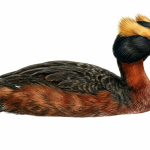
Red-necked Grebe
Podiceps grisegena
The Red-necked Grebe is a rare migrant to Britain, typically seen during the spring and autumn migrations, often in coastal areas with calm waters. It can be spotted in the country's southern and eastern regions, particularly around large lakes, estuaries, and marine coasts.
Field Identification Guide
Use these features to identify Red-necked Grebe in the field.
The Red-necked Grebe can be identified by its distinctive red neck, yellow bill, and black cap, which distinguish it from other grebe species. Its grey back and white underparts also help to set it apart.
The Red-necked Grebe is slightly larger than a Moorhen, with a more slender build.
The male Red-necked Grebe has a distinctive breeding plumage, characterized by a bright red neck, black cap, and grey back, with white underparts and a yellow bill.
The female Red-necked Grebe is similar to the male, with the same distinctive red neck and black cap, although her colours may be slightly duller.
The Red-necked Grebe's call is a loud, wailing "ku-ku-ku" or "ga-ga-ga" sound, often heard during the breeding season.
Red-necked Grebes are diving birds, feeding on fish, crustaceans, and insects in the water, and are known for their rapid, low-flight style over the surface of the water. They are also monogamous, with pairs forming during the breeding season.
The Red-necked Grebe can be confused with the Great Crested Grebe, but can be distinguished by its smaller size, brighter red neck, and lack of a crest.
Quick Facts
Who's spotted this?
Loading...
Recent community sightings
Loading recent sightings...