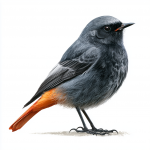
Rose-breasted Grosbeak
Pheucticus ludovicianus
The Rose-breasted Grosbeak is a rare migrant to Britain, typically seen during the spring and autumn, particularly in the southern and eastern regions. It is a notable species due to its distinctive plumage and large size, making it a sought-after sighting for British birdwatchers.
Field Identification Guide
Use these features to identify Rose-breasted Grosbeak in the field.
The key identification features of the Rose-breasted Grosbeak include its black head, wings, and tail, contrasted with a bright rose-coloured patch on its white breast, as well as its large, seed-eating beak.
The Rose-breasted Grosbeak is larger than a Blue Tit, but smaller than a Starling, making it a medium-sized bird with a sturdy build.
The male Rose-breasted Grosbeak has a distinctive black head, wings, back, and tail, with a bright rose-coloured patch on its white breast, creating a striking visual effect.
The female Rose-breasted Grosbeak exhibits marked sexual dimorphism, with a brownish-grey head, wings, and back, and a pale buff-coloured breast, lacking the bright rose-coloured patch of the male.
The Rose-breasted Grosbeak's call is a sharp, metallic "chink" or "tik" sound, while its song is a series of short, melodic phrases.
The Rose-breasted Grosbeak is primarily a foliage gleaner, feeding on seeds, fruits, and insects, and can be seen foraging in trees and shrubs, often with a deliberate and slow flight style.
The Rose-breasted Grosbeak can be confused with other grosbeak species, but can be distinguished by its distinctive rose-coloured breast patch and black head, which sets it apart from similar species such as the Hawfinch and the Bullfinch.
Quick Facts
Who's spotted this?
Loading...
Recent community sightings
Loading recent sightings...