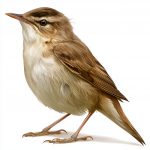
Ruby-crowned Kinglet
Corthylio calendula
The Ruby-crowned Kinglet is a rare visitor to Britain, typically seen during migration periods or as a vagrant, and can be spotted in woodland edges and scrubby areas. It is a small, energetic bird that is more commonly found in North America, making sightings in Britain a notable event.
Field Identification Guide
Use these features to identify Ruby-crowned Kinglet in the field.
The Ruby-crowned Kinglet can be identified by its olive-green plumage, white eye-ring, and two white wing bars, with the male's distinctive red crown patch being a key distinguishing feature. The white eye-ring and wing bars are also prominent identification features.
The Ruby-crowned Kinglet is smaller than a Blue Tit, making it one of the smallest songbirds that can be seen in Britain.
The male Ruby-crowned Kinglet has olive-green plumage with a distinctive red crown patch, which is often concealed, and two white wing bars. The red crown patch is a key identification feature, but it may not always be visible.
The female Ruby-crowned Kinglet is similar to the male but lacks the red crown patch, with the rest of the plumage being identical, featuring olive-green feathers and white wing bars.
The Ruby-crowned Kinglet's call is a series of high-pitched, tinkling notes, often described as a rapid, musical phrase.
The Ruby-crowned Kinglet is an active and agile bird, often seen flitting between branches in search of insects and spiders, and can be recognized by its rapid, darting flight style.
The Ruby-crowned Kinglet can be confused with the Goldcrest, but can be distinguished by its white eye-ring and wing bars, as well as its lack of a yellow or gold crown patch, and its more subdued, olive-green plumage.
Quick Facts
Who's spotted this?
Loading...
Recent community sightings
Loading recent sightings...