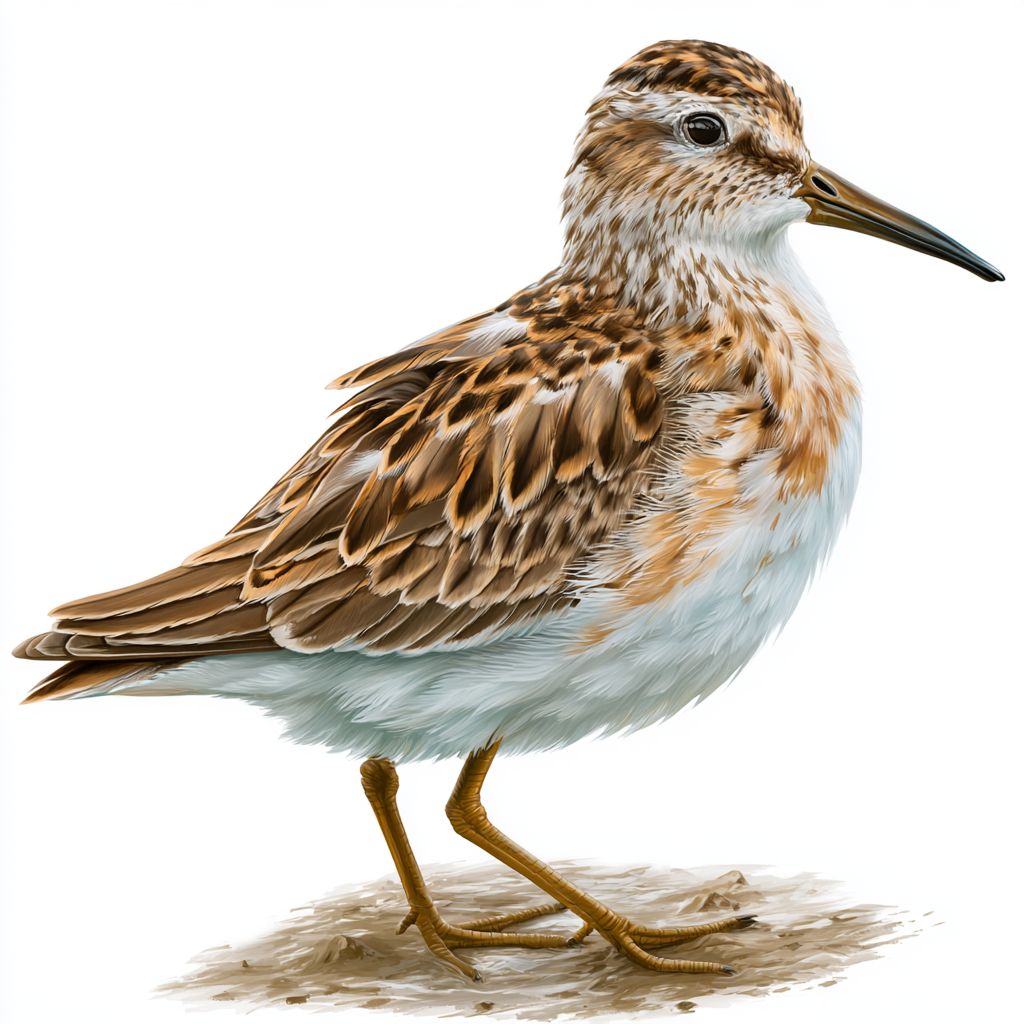
Sharp-tailed Sandpiper
Calidris acuminata
The Sharp-tailed Sandpiper is a rare migrant to Britain, typically seen during the autumn, with most sightings occurring in the eastern and southern coastal regions. It can be spotted in a variety of wetland habitats, including estuaries, marshes, and muddy shores.
Field Identification Guide
Use these features to identify Sharp-tailed Sandpiper in the field.
The Sharp-tailed Sandpiper can be identified by its distinctive long, pointed tail feathers, dark brown back with pale edges to the feathers, and a pale breast with a dark brown patch on the chest. Its relatively long legs and straight, black bill are also notable features.
The Sharp-tailed Sandpiper is slightly larger than a Dunlin, but smaller than a Redshank, making it a medium-sized wader.
The male Sharp-tailed Sandpiper has a breeding plumage characterized by a dark brown back with rufous edges to the feathers, a pale breast, and a dark brown patch on the chest, which is most pronounced during the summer months.
The female Sharp-tailed Sandpiper is similar to the male, with a slightly less intense breeding plumage, but the differences are not always distinct.
The Sharp-tailed Sandpiper's call is a sharp, high-pitched "chip" or "tzeep" sound, often repeated in a series of three or four notes.
The Sharp-tailed Sandpiper is a migratory species that feeds on small invertebrates, such as insects and crustaceans, in wetland habitats, and can be seen flying in flocks with other wader species, often with a swift, direct flight style.
The Sharp-tailed Sandpiper can be confused with the Pectoral Sandpiper, but can be distinguished by its longer, more pointed tail feathers and a darker brown back with more pronounced pale edges to the feathers.
Quick Facts
Who's spotted this?
Loading...
Recent community sightings
Loading recent sightings...


