Tawny Pipit
Anthus campestris
The Tawny Pipit is a rare migrant to Britain, typically seen during the spring and autumn migrations, often in open countryside and coastal areas. It is most likely to be spotted by keen birdwatchers in the southern parts of the country, particularly in areas with low vegetation and bare ground.
Field Identification Guide
Use these features to identify Tawny Pipit in the field.
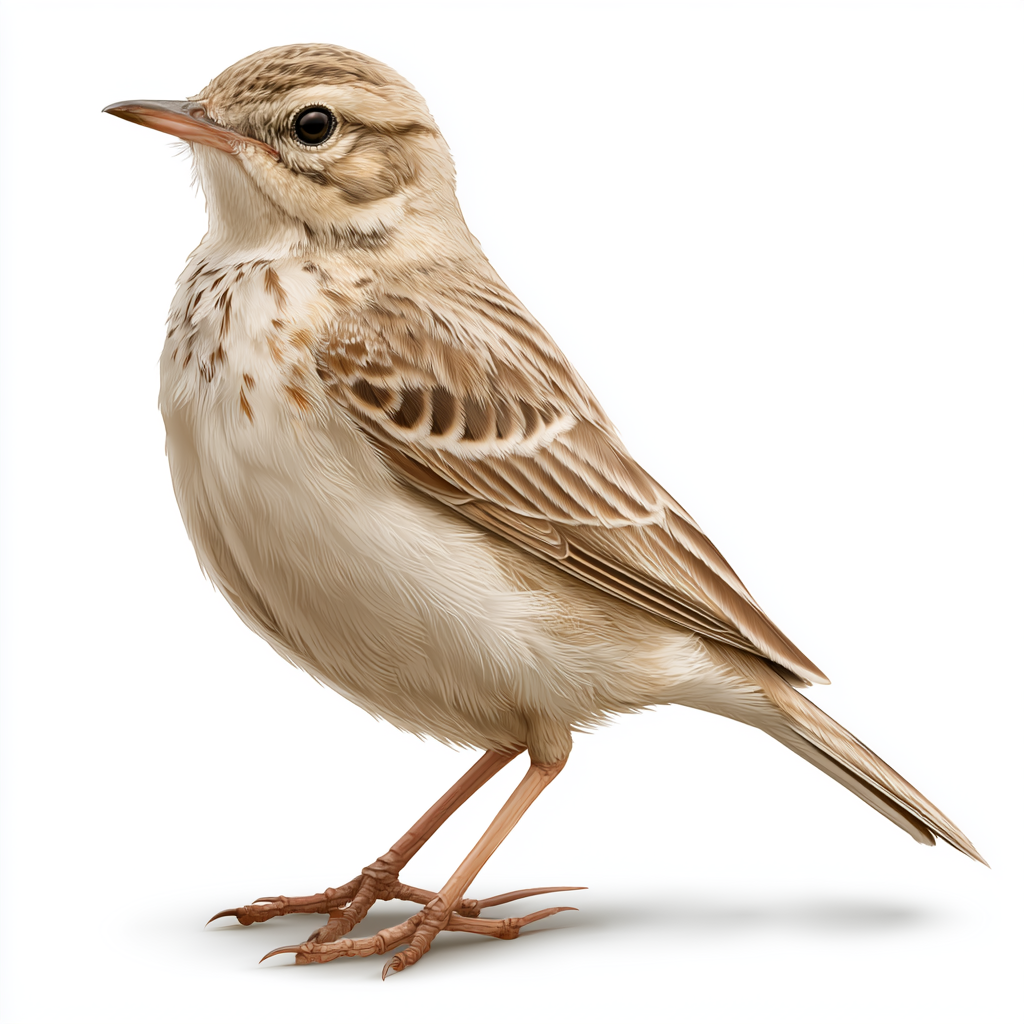
The Tawny Pipit can be identified at a glance by its streaked breast, pale yellow-buff underside, and distinctive white outer tail feathers. Its upperparts are a warm brown colour with dark streaks, and it has a long, pointed bill.
The Tawny Pipit is slightly smaller than a Meadow Pipit, but larger than a Blue Tit, with a length of around 14-15 cm.
The male Tawny Pipit has a warm brown back with dark streaks, a streaked breast, and a pale yellow-buff belly, with a distinctive white wing bar and white outer tail feathers. Its plumage remains relatively consistent throughout the year, with little seasonal variation.
The female Tawny Pipit is similar to the male, with the same warm brown upperparts and streaked breast, although it may be slightly duller in colour.
The Tawny Pipit's call is a sharp, metallic "tzeep" or "tzee", often repeated in a series, while its song is a series of short, melodic phrases, often sung from a low perch or in flight.
The Tawny Pipit is a ground-dwelling bird that feeds on insects, seeds, and small invertebrates, often running or walking on the ground to catch its prey. It has a distinctive flight style, with a series of rapid wingbeats followed by a brief glide.
The Tawny Pipit can be confused with other pipit species, such as the Meadow Pipit or the Tree Pipit, but can be distinguished by its warmer brown upperparts, streaked breast, and white outer tail feathers.
Quick Facts
Who's spotted this?
Loading...
Recent community sightings
Loading recent sightings...