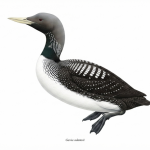
Tennessee Warbler
Leiothlypis peregrina
The Tennessee Warbler is a rare migrant to Britain, typically seen during the autumn, with most sightings occurring on the eastern and southern coasts. It is a North American species that occasionally wanders to British shores, often in the company of other Nearctic warblers.
Field Identification Guide
Use these features to identify Tennessee Warbler in the field.
The Tennessee Warbler can be identified by its grey head, white undertail coverts, and distinctive white eye-ring, as well as its olive-green back and wings. Its breast and belly are yellow, with a subtle greyish tint on the breast.
The Tennessee Warbler is smaller than a Blackcap, measuring around 10-12 cm in length, which is roughly the same size as a Goldcrest.
The male Tennessee Warbler has a grey head, olive-green back and wings, and yellow breast and belly, with a subtle greyish tint on the breast, and white undertail coverts.
The female Tennessee Warbler is similar to the male, but with a slightly browner tint to the head and back, and a less pronounced greyish breast.
The Tennessee Warbler's call is a sharp, high-pitched "tik" or "chip", often repeated in a series, while its song is a melodic, whistled phrase, typically heard during the breeding season in North America.
The Tennessee Warbler is an active, insectivorous bird that forages for small invertebrates in trees and shrubs, often flying between branches with a rapid, darting motion.
The Tennessee Warbler can be confused with other warbler species, such as the Yellow Warbler or the Chestnut-sided Warbler, but can be distinguished by its grey head, white eye-ring, and olive-green back, as well as its distinctive white undertail coverts.
Quick Facts
Who's spotted this?
Loading...
Recent community sightings
Loading recent sightings...