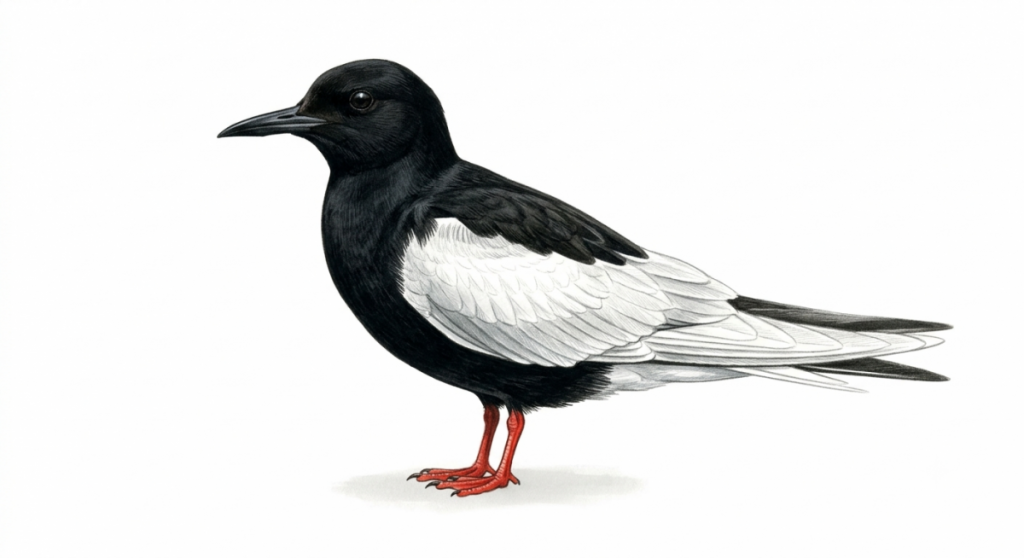
White-winged Black Tern
Chlidonias leucopterus
The White-winged Black Tern is a rare migrant to Britain, typically seen near freshwater bodies during the summer months, although sightings are infrequent and often associated with periods of easterly winds. It can be spotted in various wetland areas, including marshes, lakes, and rivers, usually between May and September.
Field Identification Guide
Use these features to identify White-winged Black Tern in the field.
This species is distinguished by its sleek black plumage, white wing bars, and a distinctive forked tail, with the white wing patches being a key identification feature. Its black head and body, combined with the white wing bars, make it a striking sight in flight.
The White-winged Black Tern is smaller than a Starling, with a more slender build and longer, more pointed wings.
The male White-winged Black Tern has a glossy black plumage with white wing bars, a white rump, and a forked tail, with the black colouration being more intense during the breeding season.
The female plumage is similar to the male, with the same black and white colouration, although the intensity of the black may be slightly less pronounced.
The call of the White-winged Black Tern is a sharp, high-pitched "kyik" or "kip" sound, often repeated in a series of short, staccato notes.
This species is known for its agile and swift flight, often hovering above the water's surface in search of small fish, insects, and crustaceans to feed on, and can be seen flying low over wetlands with rapid, darting movements.
The White-winged Black Tern can be confused with the Black Tern, but can be distinguished by its white wing bars and more slender build, as well as its forked tail and white rump patch.
Quick Facts
Who's spotted this?
Loading...
Recent community sightings
Loading recent sightings...


