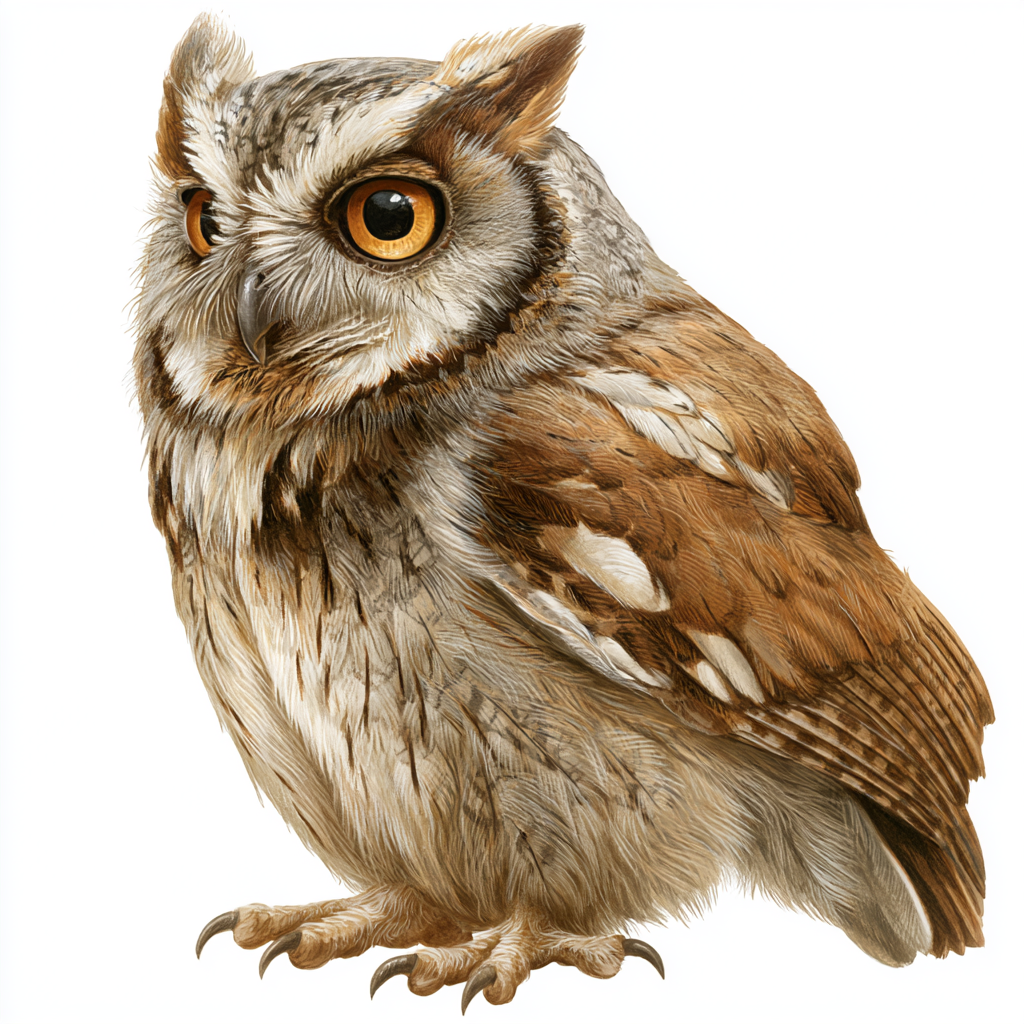
Scops Owl
Otus scops
The Scops Owl is a rare summer migrant to Britain, typically seen in the southern regions during the warmer months, and is notable for its compact size and camouflage plumage. It is most often encountered in woodland edges and scrubby areas, particularly at dusk or dawn when it is most active.
Field Identification Guide
Use these features to identify Scops Owl in the field.
The Scops Owl can be identified by its brownish hues, lighter underside and face, and compact shape, with some individuals displaying a greyish- or reddish-brown morph. Its facial disc and lack of ear tufts are also distinctive features.
The Scops Owl is smaller than a Starling, with a compact body shape that allows it to blend into its surroundings.
The male Scops Owl has a plumage of various brownish hues, sometimes with a lighter underside and face, and can occur in a greyish- or reddish-brown morph, although the specific colours and patterns can vary.
The female Scops Owl is similar to the male in terms of plumage, but is usually larger in size, with the same range of brownish hues and potential for greyish- or reddish-brown morphs.
The Scops Owl has a distinctive call that sounds like a low, mournful whistle, often described as a repetitive, whistled "tu-tu-tu" or "hoo-hoo-hoo" sound.
The Scops Owl is a nocturnal hunter, using its acute hearing and exceptional night vision to catch insects and small vertebrates, and can be seen flying with a slow, fluttering wingbeat as it searches for prey.
The Scops Owl can be confused with other small owl species, such as the Little Owl or the Tawny Owl, but can be distinguished by its lack of ear tufts, compact shape, and distinctive call, as well as its more subdued, brownish plumage.
Quick Facts
Who's spotted this?
Loading...
Recent community sightings
Loading recent sightings...


