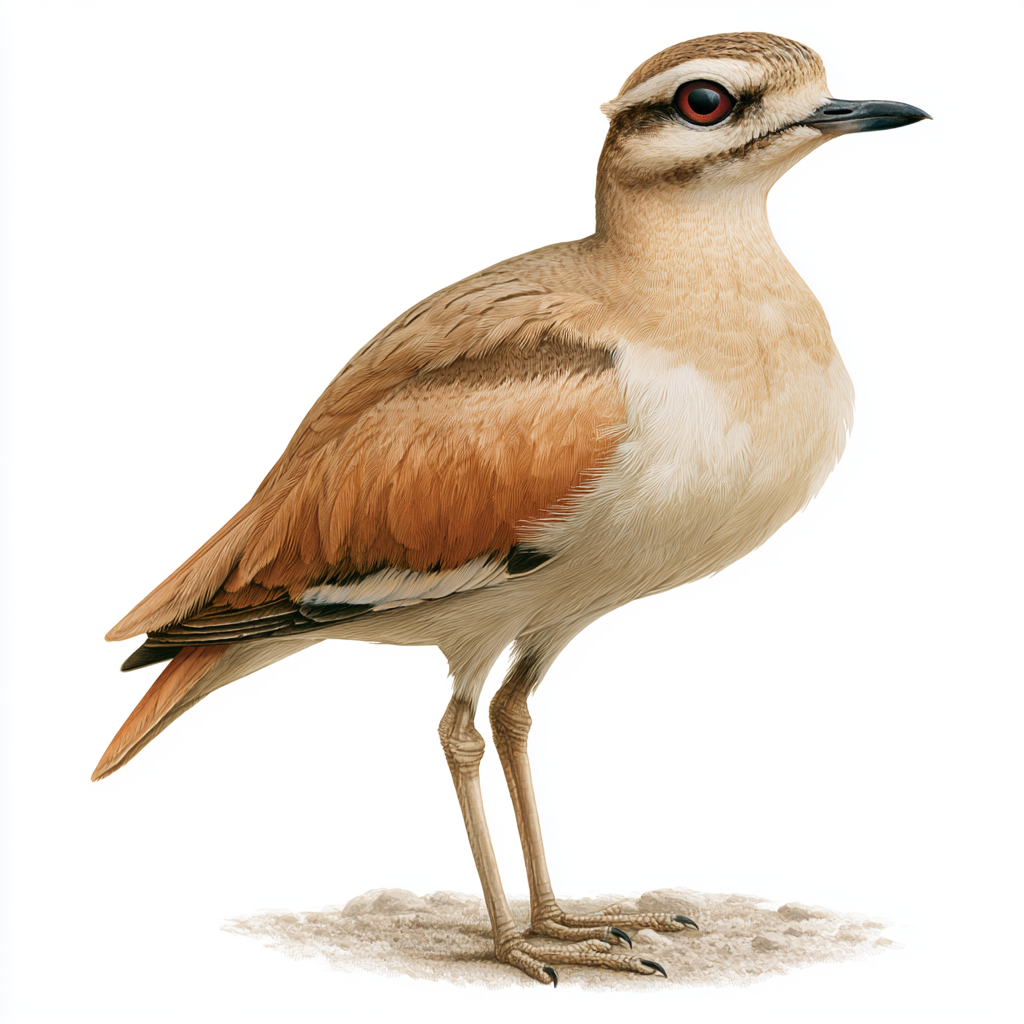
Cream-coloured Courser
Cursorius cursor
The Cream-coloured Courser is a rare and occasional visitor to Britain, typically seen during periods of migration or as a vagrant in the southern regions, particularly in dry, open areas. It is more commonly found in its native habitats of the Middle East and northern Africa, where it inhabits dry open semi-desert regions.
Field Identification Guide
Use these features to identify Cream-coloured Courser in the field.
The Cream-coloured Courser can be identified by its distinctive cream-coloured plumage, long legs, and a black stripe that runs above its eye, with a distinctive white stripe above the black stripe. Its overall shape and long wings also distinguish it from other similar species.
The Cream-coloured Courser is slightly larger than a Lapwing, with a more slender build, making it a notable sight when seen in the UK.
The male Cream-coloured Courser has a cream-coloured back and wings, with a white belly and a black stripe above its eye, with a distinctive white stripe above the black stripe, and its plumage remains relatively consistent throughout the year.
The female Cream-coloured Courser is similar to the male, with no significant differences in plumage, making it difficult to distinguish between the sexes based on appearance alone.
The Cream-coloured Courser has a sharp, high-pitched call, often described as a loud, shrill "kek" or "kik" sound, which is frequently used for contact and alarm.
The Cream-coloured Courser is a ground-dwelling bird that runs quickly to catch its insect prey, and is known for its swift and agile flight, often flying low to the ground with its long wings held downward.
The Cream-coloured Courser can be confused with the Collared Pratincole, but can be distinguished by its lack of a collar and its more slender build, as well as its distinctive black and white stripe above its eye.
Quick Facts
Who's spotted this?
Loading...
Recent community sightings
Loading recent sightings...