Royal Tern
Thalasseus maximus
The Royal Tern is a rare vagrant to Britain, with sightings mostly occurring along the southern and western coasts, particularly during the summer months. It is a distinctive tern species that can be spotted in the UK, although such encounters are infrequent and often associated with stormy weather.
Field Identification Guide
Use these features to identify Royal Tern in the field.
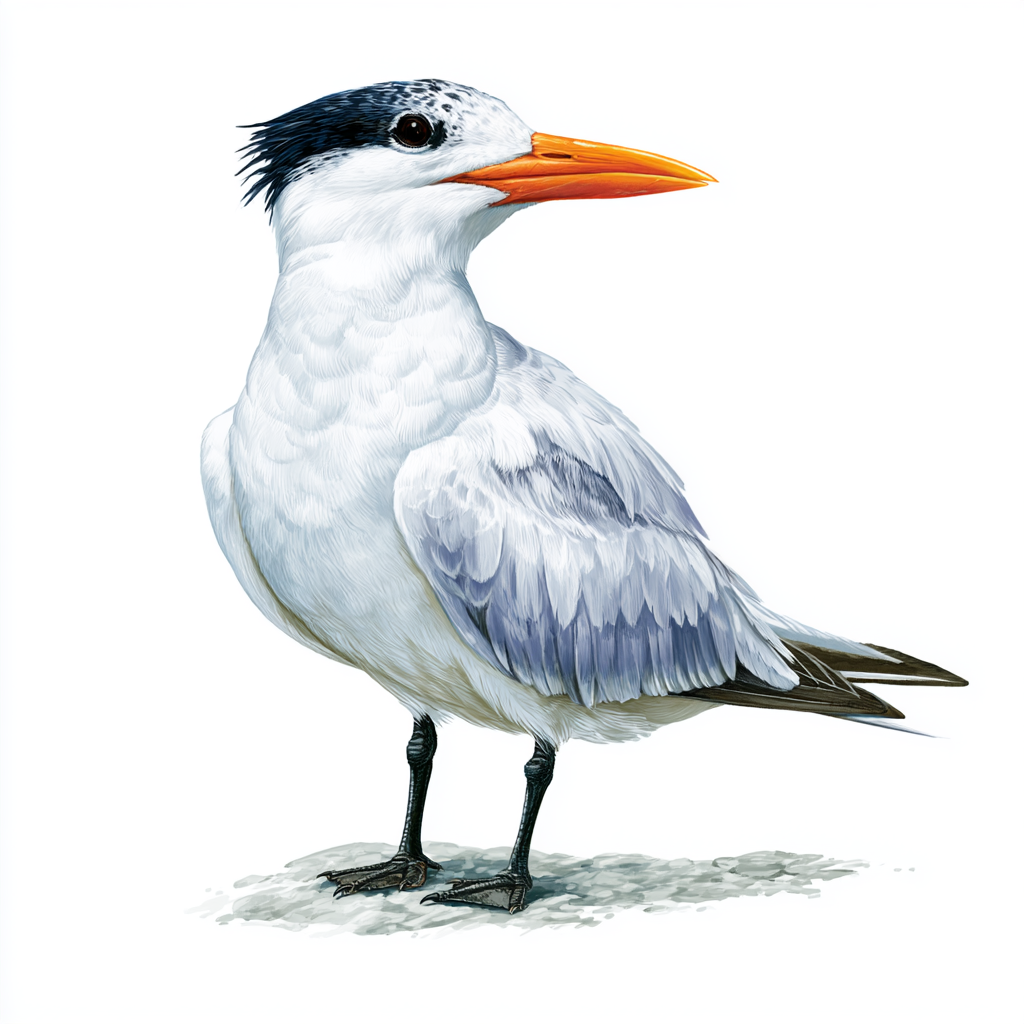
The Royal Tern can be identified by its grey back, white forehead, and a distinctive orange-red bill, as well as its relatively large size and broad wings. Its black crown and nape during the breeding season are also notable features.
The Royal Tern is larger than a Common Tern, with a size comparable to a small gull, such as the Lesser Black-backed Gull.
The male Royal Tern has a grey back, white belly, and a black crown and nape during the breeding season, with a distinctive orange-red bill, while in non-breeding plumage, the black crown and nape are replaced by a greyish-white colouration.
Similar to the male, the female Royal Tern's plumage is virtually indistinguishable, with the same grey, white, and black colouration, although the orange-red bill may be slightly less vibrant.
The Royal Tern's call is a loud, sharp "kleek" or "kek", often repeated in a series of shrill, high-pitched notes.
Royal Terns are fish-eating birds that dive from the air to catch their prey, and they can be seen flying low over the water, scanning for fish, before plunging downwards to catch their quarry.
The Royal Tern can be confused with other tern species, such as the Lesser Crested Tern or the Caspian Tern, but it can be distinguished by its larger size, broader wings, and distinctive orange-red bill, as well as its grey back and white forehead.
Quick Facts
Who's spotted this?
Loading...
Recent community sightings
Loading recent sightings...