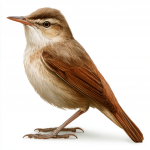
Lark Sparrow
Chondestes grammacus
The Lark Sparrow is a rare visitor to Britain, typically seen during migration periods or as a vagrant, and is notable for being the only member of its genus. It is most likely to be spotted in the southern regions of England, particularly during the spring and autumn.
Field Identification Guide
Use these features to identify Lark Sparrow in the field.
The Lark Sparrow can be identified at a glance by its distinctive black spot on its chest, white stripes on its head, and a mix of brown and grey plumage. Its head pattern, featuring a white stripe above and below its eye, is also a key distinguishing feature.
The Lark Sparrow is slightly smaller than a Starling, but larger than a Blue Tit, making it a fairly medium-sized sparrow.
The male Lark Sparrow has a brown back, wings, and tail, with a grey breast and belly, and a distinctive black spot on its chest, surrounded by a white stripe above and below its eye.
The female Lark Sparrow is similar to the male, with slightly duller colours and a less pronounced black spot on its chest.
The Lark Sparrow's call is a series of descending whistled notes, often described as a melancholic or mournful sound.
The Lark Sparrow is a ground-foraging bird, feeding on seeds, insects, and fruits, and is often seen running or walking on the ground in search of food, with a distinctive flight style featuring rapid wingbeats.
The Lark Sparrow can be confused with other sparrow species, such as the Tree Sparrow, but can be distinguished by its distinctive head pattern, black chest spot, and grey breast, which are not found in other British sparrow species.
Quick Facts
Who's spotted this?
Loading...
Recent community sightings
Loading recent sightings...