Semipalmated Plover
Charadrius semipalmatus
The Semipalmated Plover is a rare migrant to Britain, typically seen during the autumn, with most sightings occurring along the eastern and southern coasts. It is a small, ground-dwelling bird that can be found in a variety of habitats, including mudflats, beaches, and wet meadows.
Field Identification Guide
Use these features to identify Semipalmated Plover in the field.
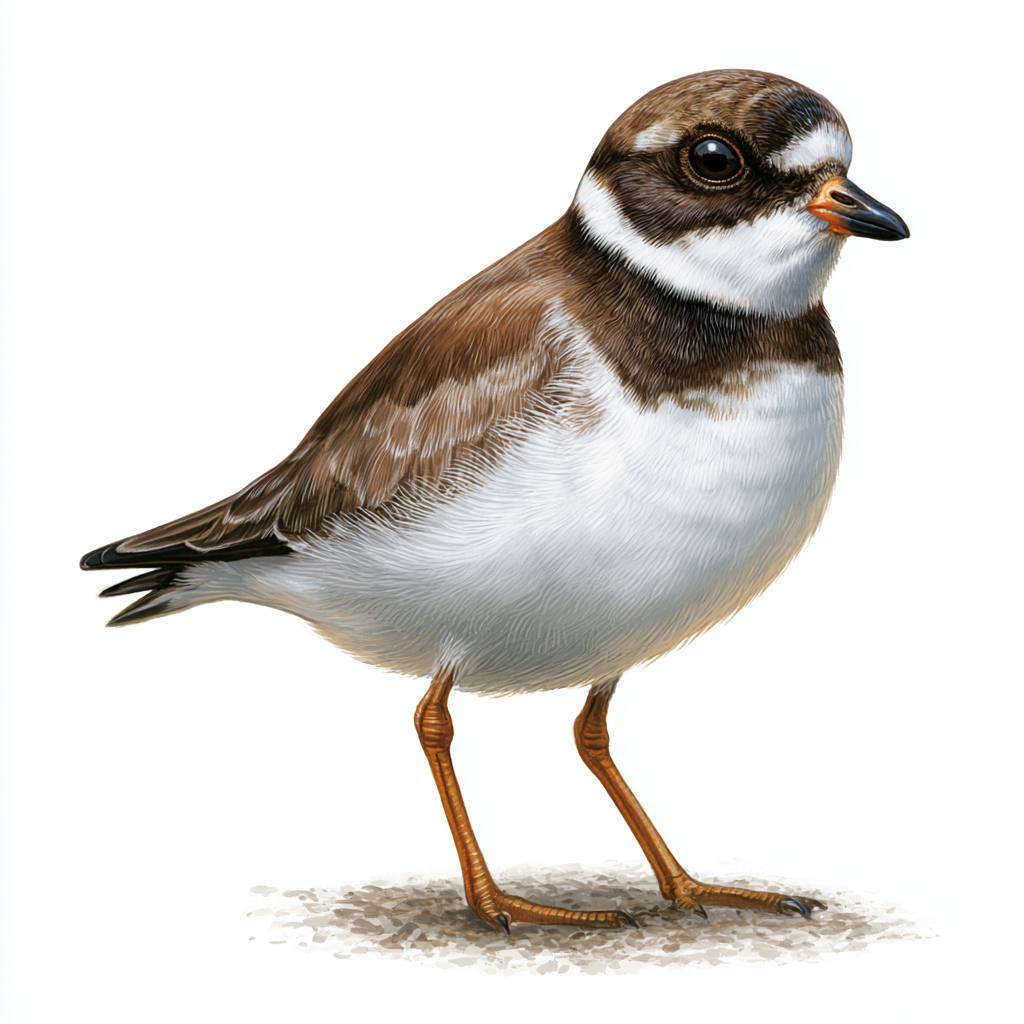
The Semipalmated Plover can be identified by its brown back and wings, white belly, and distinctive black neck band, as well as its relatively small size and short black bill. Its partial webbing between its toes is also a key feature, although this may be difficult to observe in the field.
The Semipalmated Plover is smaller than a Starling, measuring approximately 18-20 cm in length.
The male Semipalmated Plover has a brown back and wings, with a white belly and a black neck band that is most pronounced during the breeding season, which is typically not seen in Britain as the species is a rare migrant.
The female Semipalmated Plover is similar to the male, although the black neck band may be less distinct or absent, especially outside of the breeding season.
The Semipalmated Plover's call is a high-pitched, whistled "chu-wee" or "pee-wee", often repeated in a series.
Semipalmated Plovers are ground-dwelling birds that feed on small invertebrates, such as insects and crustaceans, which they pick up from the surface or probe for in the mud and sand. They are also known for their rapid, direct flight style.
The Semipalmated Plover can be confused with the Ringed Plover, but can be distinguished by its smaller size, shorter bill, and partial webbing between its toes, as well as its more subdued plumage patterns.
Quick Facts
Who's spotted this?
Loading...
Recent community sightings
Loading recent sightings...