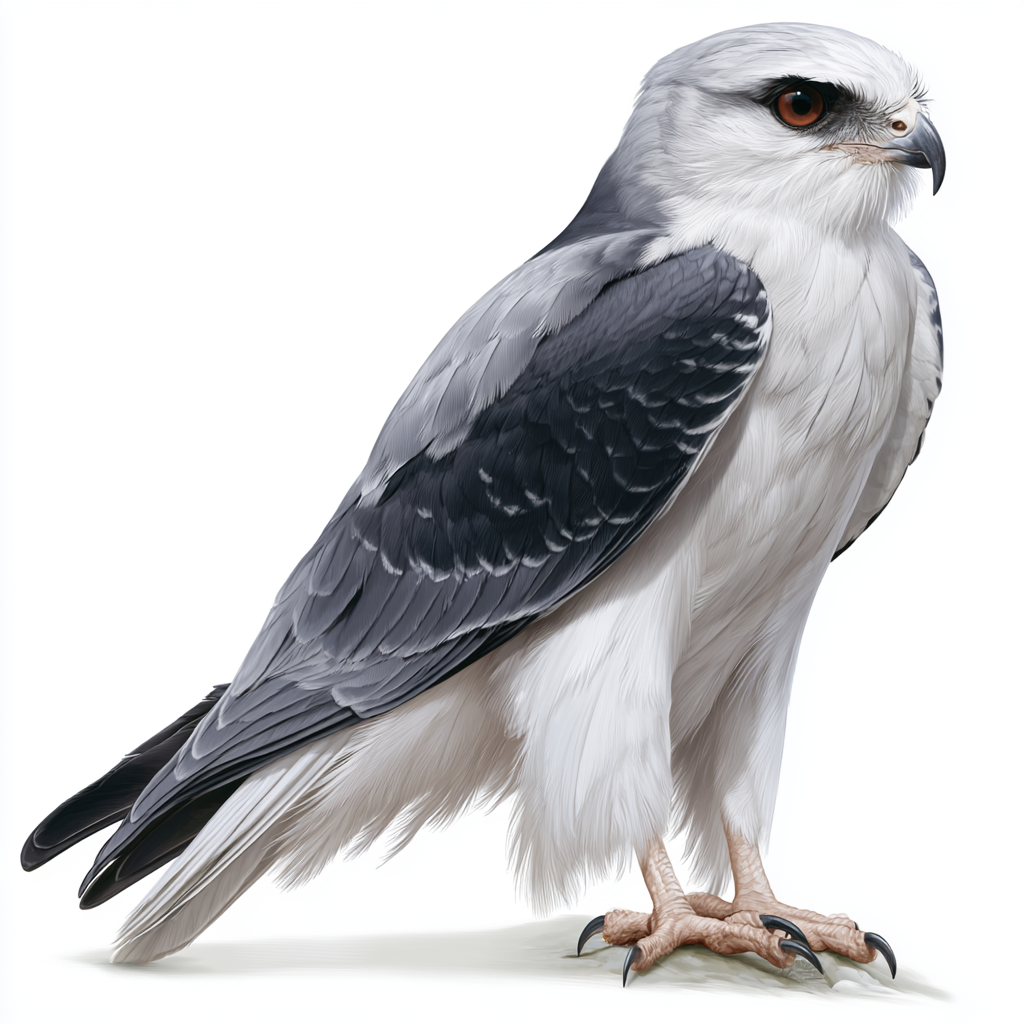
Black-winged Kite
Elanus caeruleus
The Black-winged Kite is a rare but occasional visitor to Britain, typically seen during the summer months, particularly in the southern regions, with sightings often associated with warm, dry weather. It is a bird of open habitats, including grasslands, heathlands, and coastal areas.
Field Identification Guide
Use these features to identify Black-winged Kite in the field.
The Black-winged Kite can be identified by its pale grey and white plumage, black wing tips, and a distinctive white forked tail, with a black subterminal band. Its pale underside and black carpals are also notable features.
The Black-winged Kite is slightly smaller than a Kestrel, with a more slender build.
The male Black-winged Kite has a pale grey back, white underside, and black wing tips, with a white forked tail and a black subterminal band, showing little seasonal variation.
Similar to the male, with no significant differences in plumage.
The Black-winged Kite has a high-pitched, whistling call, often described as a sharp, piercing "pee-pee-pee" or "kee-kee-kee".
The Black-winged Kite is a hover-hunting specialist, typically flying slowly over open areas, scanning for small mammals, insects, and other invertebrates, before dropping down to catch its prey.
The Black-winged Kite can be confused with the Red Kite, but can be distinguished by its smaller size, pale grey and white plumage, and distinctive black wing tips and forked tail, as well as its more slender build and hovering flight style.
Quick Facts
Who's spotted this?
Loading...
Recent community sightings
Loading recent sightings...