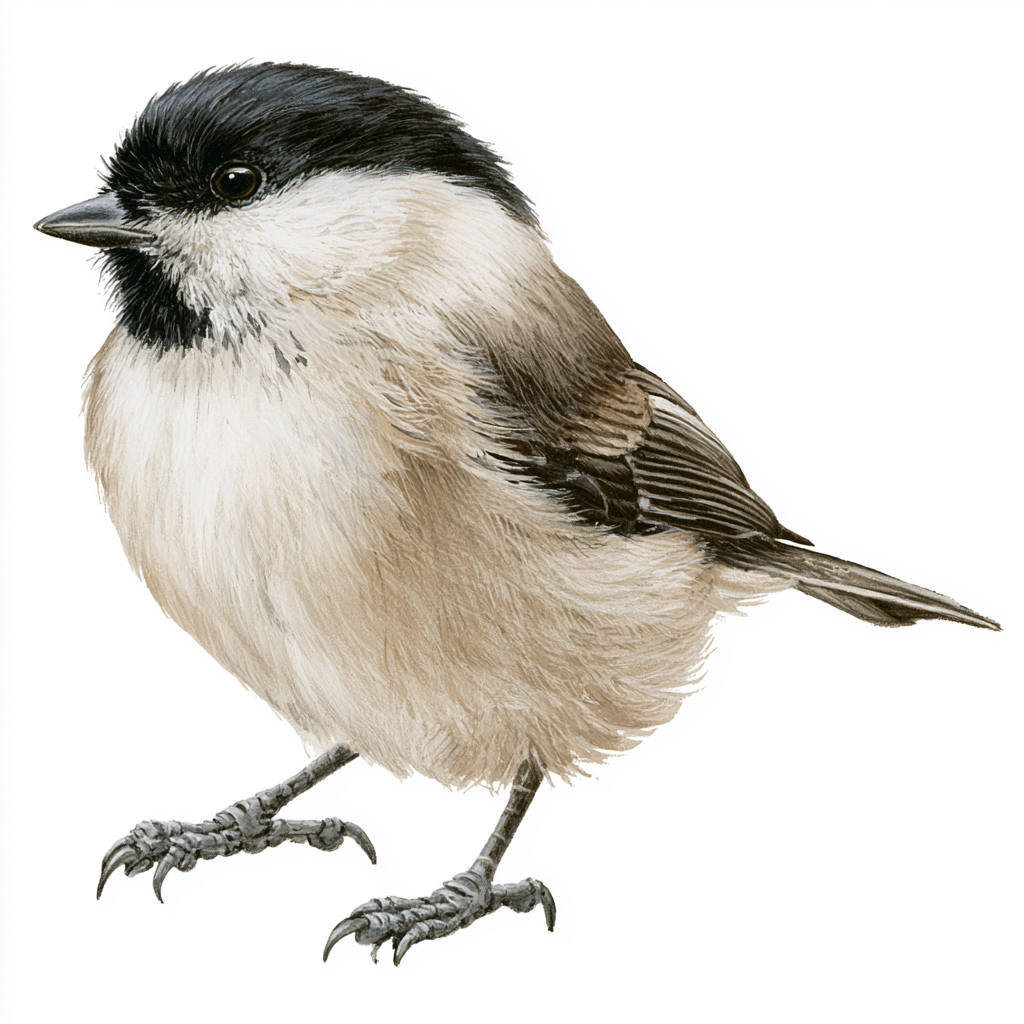
Willow Tit
Poecile montanus
The Willow Tit is a common resident breeder in Britain, typically seen in woodland edges, marshes, and wetlands, particularly in the north and west of the country, with sightings possible year-round. It is more frequently encountered in areas with coniferous trees, where it can be spotted foraging for food or nesting.
Field Identification Guide
Use these features to identify Willow Tit in the field.
The Willow Tit can be identified by its grey-brown plumage, distinctive black cap, and black bib, as well as its white cheeks and off-white underside. Its black cap and bib are key distinguishing features, setting it apart from other tit species.
The Willow Tit is slightly smaller than a Blue Tit, but larger than a Goldcrest, making it a medium-sized tit species.
The male Willow Tit has a grey-brown back, wings, and tail, with a black cap and bib, and white cheeks and off-white underside, with no significant seasonal variation in its plumage.
The female Willow Tit has similar plumage to the male, with no notable differences in colour or pattern.
The Willow Tit's call is a nasal, wheezing "zee-zee-zee" or "pee-pee-pee", often repeated in a series, while its song is a simple, repetitive phrase.
The Willow Tit is an active, acrobatic bird that forages for insects, seeds, and nuts in trees and shrubs, often climbing up and down trunks and branches with ease, and flying in a direct, purposeful manner.
The Willow Tit can be confused with the Marsh Tit, but can be distinguished by its pale-looking face, with white cheeks and a less distinctive white stripe above the eye, as well as its more coniferous habitat preferences.
Quick Facts
Who's spotted this?
Loading...
Recent community sightings
Loading recent sightings...


