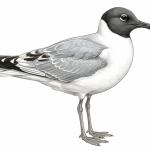
Cirl Bunting
Emberiza cirlus
The Cirl Bunting is a rare but breeding species in Britain, primarily found in the southern regions, particularly in Devon and Cornwall, where it can be seen from April to October. It is a summer visitor to the UK, with the majority of sightings occurring during the spring and summer months.
Field Identification Guide
Use these features to identify Cirl Bunting in the field.
The Cirl Bunting can be identified by its distinctive greenish-yellow plumage, grey-brown back, and white wing bars, as well as its stout bill and rounded tail. Its black stripe above the eye and pale yellow breast are also key features.
The Cirl Bunting is slightly smaller than a Starling, measuring around 15-16 cm in length.
The male Cirl Bunting has a bright yellow-green head, breast, and belly, with a grey-brown back, white wing bars, and a black stripe above the eye, with little seasonal variation in its plumage.
The female Cirl Bunting has a similar but duller plumage to the male, with a more subdued yellow-green colouration and less pronounced markings.
The Cirl Bunting's song is a series of short, melodic phrases, often described as a repetitive and rhythmic "teez-teez-teez", while its call is a sharp, metallic "tek" sound.
The Cirl Bunting is a ground-foraging bird, feeding on seeds, insects, and spiders, and can be seen walking or running on the ground in search of food, with a distinctive bobbing motion as it moves.
The Cirl Bunting can be confused with the Yellowhammer, but can be distinguished by its brighter yellow-green plumage, black stripe above the eye, and white wing bars, as well as its more rounded tail and stout bill.
Quick Facts
Who's spotted this?
Loading...
Recent community sightings
Loading recent sightings...