Ovenbird
Seiurus aurocapilla
The Ovenbird is a rare migrant to Britain, typically seen during the autumn months, particularly on the eastern and southern coasts. It is a small, ground-dwelling warbler that can be spotted in woodland edges and scrubby areas.
Field Identification Guide
Use these features to identify Ovenbird in the field.
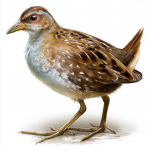
The Ovenbird can be identified by its distinctive orange crown, white eye ring, and black-and-brown striped back, which distinguish it from other warblers. Its rounded tail and short, pink legs are also notable features.
The Ovenbird is slightly smaller than a Robin, measuring around 11-12 cm in length.
The male Ovenbird has a bright orange crown, white throat patch, and a black-and-brown striped back, with a greenish-olive tint to its wings and tail.
The female Ovenbird is similar to the male, but with a slightly duller orange crown and less pronounced striping on its back.
The Ovenbird's call is a sharp, metallic "chink" or "tink" sound, while its song is a series of descending musical phrases, often described as a whistled "teach-er, teach-er, teach-er".
The Ovenbird is a ground-foraging bird, feeding on insects, spiders, and other small invertebrates, and is often seen walking or running along the forest floor with its tail held upright.
The Ovenbird can be confused with other warblers, such as the Black-and-white Warbler, but can be distinguished by its orange crown, white eye ring, and distinctive call.
Quick Facts
Who's spotted this?
Loading...
Recent community sightings
Loading recent sightings...