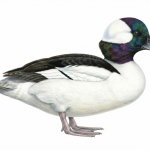
Long-billed Murrelet
Brachyramphus perdix
The Long-billed Murrelet is a rare and occasional visitor to British shores, typically seen in the northern and western coastal areas, particularly during the summer months. It is a small seabird that can be spotted in British waters, although sightings are extremely rare and often associated with exceptional weather events.
Field Identification Guide
Use these features to identify Long-billed Murrelet in the field.
The Long-billed Murrelet can be identified by its distinctive black and white plumage, short neck, and long, pointed bill, as well as its small size and rapid wingbeats. Its white undersides and black back provide a clear contrast, making it recognizable at a glance.
The Long-billed Murrelet is smaller than a Starling, measuring around 20-25 cm in length, and is one of the smallest auks found in the North Pacific.
The male Long-billed Murrelet has a black back, wings, and head, with a white belly, throat, and patches above the eyes, and its plumage remains largely consistent throughout the year.
The female Long-billed Murrelet has similar plumage to the male, with no notable seasonal or sexual variations in its black and white colouration.
The Long-billed Murrelet's call is a high-pitched, whistling sound, often described as a sharp, piercing whistle, although it is not typically vocal in British waters.
The Long-billed Murrelet is a pelagic bird that feeds on small fish, crustaceans, and plankton, often diving and pursuing prey underwater, and is known for its rapid, fluttering wingbeats and agile flight.
The Long-billed Murrelet can be confused with other small auks, such as the Guillemot or the Puffin, but can be distinguished by its distinctive black and white plumage, long bill, and small size, as well as its rapid wingbeats and agile flight pattern.
Quick Facts
Who's spotted this?
Loading...
Recent community sightings
Loading recent sightings...