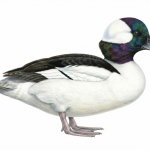
American Kestrel
Falco sparverius
The American Kestrel is a rare visitor to Britain, typically seen during migration periods or as a vagrant, and its small size and falcon-like appearance make it a notable sighting. It is most likely to be spotted in the southern regions of England, particularly during the autumn months.
Field Identification Guide
Use these features to identify American Kestrel in the field.
The American Kestrel can be identified by its rufous back with noticeable barring, slate-grey wings, and a black stripe running above its eye, distinguishing it from other falcon species. Its slate-grey tail with a black band at the tip is also a key feature.
The American Kestrel is smaller than a Starling, with a size range comparable to that of a Blue Jay or a Mourning Dove.
The male American Kestrel has a colourful plumage, featuring a rufous back with black barring, slate-grey wings, and a white underside with black spotting, with little seasonal variation in its appearance.
The female American Kestrel is similar to the male in plumage, but with a more subdued colouration and heavier barring on the back and wings.
The American Kestrel's call is a high-pitched, sharp "klee-klee-klee" or "chay-chay-chay", often repeated in a series of notes.
The American Kestrel is a hover-hunting specialist, using its agility and sharp eyesight to catch small insects and vertebrates in mid-air, and its swift, direct flight style is characteristic of the species.
The American Kestrel can be confused with the Eurasian Kestrel, but can be distinguished by its smaller size, more slate-grey wings, and a black stripe above the eye, as well as its more rufous back with black barring.
Quick Facts
Who's spotted this?
Loading...
Recent community sightings
Loading recent sightings...