Greater Sand Plover
Anarhynchus leschenaultii
The Greater Sand Plover is a rare migrant to Britain, typically seen on coastal wetlands and beaches during the spring and autumn, with most sightings occurring in the southern and eastern parts of the country. It is a small wader that can be spotted in areas with sandy or muddy shores, often in association with other shorebird species.
Field Identification Guide
Use these features to identify Greater Sand Plover in the field.
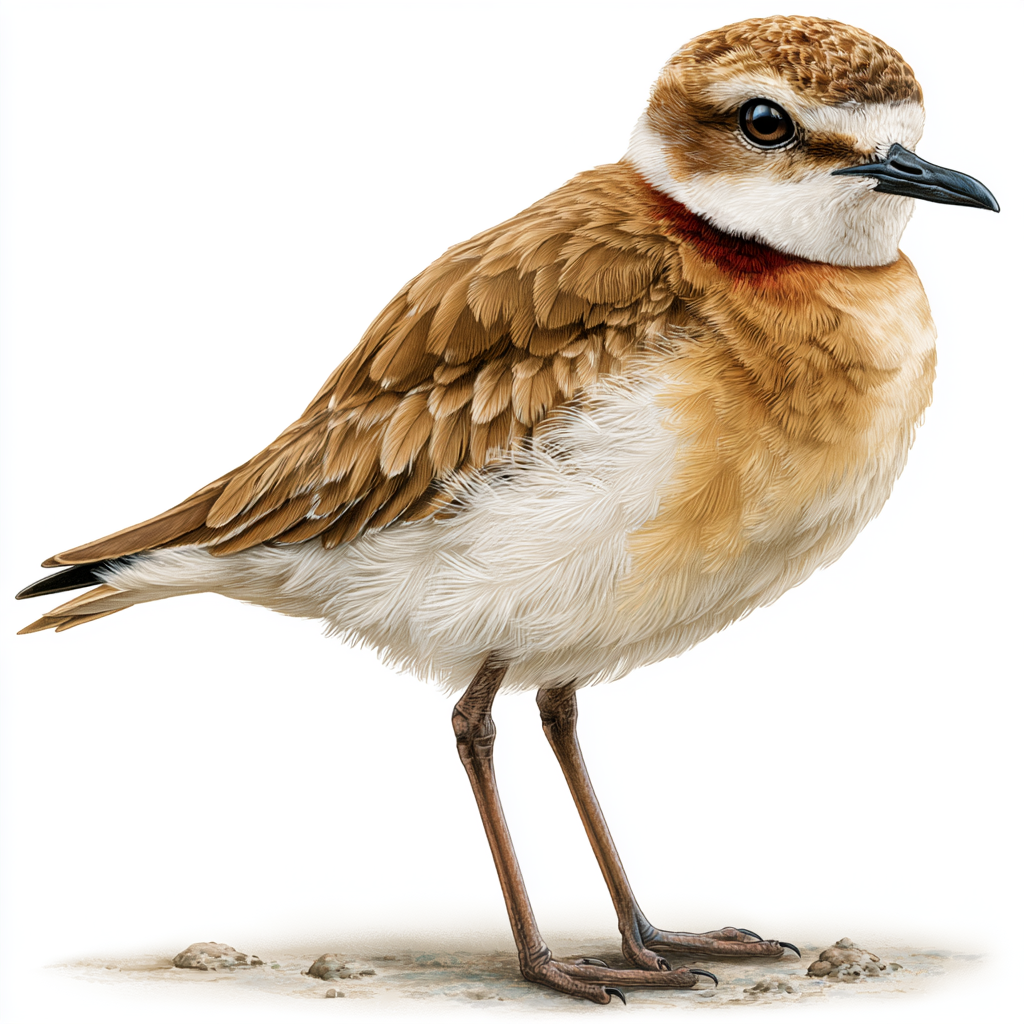
The Greater Sand Plover can be identified by its brownish-grey upperparts, white underparts, and distinctive black stripe that runs across its forehead, as well as its relatively long legs and straight black bill. Its grey-brown back and wings also help to distinguish it from other similar species.
The Greater Sand Plover is slightly larger than a Ringed Plover, but smaller than a Lapwing, making it a medium-sized wader that is easily overlooked in a crowded shoreline.
The male Greater Sand Plover has a breeding plumage that features a black stripe across its forehead, a brownish-grey back, and white underparts, with a black patch on its chest that is often visible during the summer months.
The female Greater Sand Plover is similar to the male, but often has a less pronounced black stripe on its forehead and a smaller black patch on its chest, making it slightly more difficult to distinguish from other female shorebirds.
The Greater Sand Plover has a sharp, whistled "pee-pee-pee" call that is often heard during migration and breeding periods, and is similar to the call of other plover species.
The Greater Sand Plover is a ground-foraging bird that feeds on small invertebrates, such as crustaceans and insects, and can often be seen running or standing still while scanning for prey, with a distinctive stop-start flight pattern when disturbed or in migration.
The Greater Sand Plover can be confused with the Lesser Sand Plover, but can be distinguished by its larger size, longer legs, and more pronounced black stripe on its forehead, as well as its grey-brown back and wings, which are more muted in colour than those of the Lesser Sand Plover.
Quick Facts
Who's spotted this?
Loading...
Recent community sightings
Loading recent sightings...