Western Orphean Warbler
Curruca hortensis
The Western Orphean Warbler is a rare vagrant to Britain, typically seen in the southern regions during its migration periods, with sightings often limited to the summer months. It is more commonly associated with the Mediterranean and western European regions, where it breeds before migrating to Sub-Saharan Africa for the winter.
Field Identification Guide
Use these features to identify Western Orphean Warbler in the field.
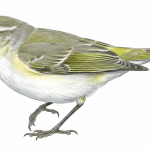
At a glance, the Western Orphean Warbler can be identified by its grey-brown back, white underside, and distinctive white eye-ring, as well as its long, rounded tail and short, pointed bill.
The Western Orphean Warbler is slightly smaller than a House Sparrow, but larger than a Goldcrest.
The male Western Orphean Warbler has a grey-brown back, wings, and tail, with a white underside and a grey head with a white eye-ring, and its plumage remains relatively consistent throughout the year.
The female Western Orphean Warbler is similar to the male, although her colours may be slightly duller, with a more subdued grey-brown tone on her back and wings.
The Western Orphean Warbler's call is a sharp, metallic "tek" or "tink" sound, while its song is a melodic, warbling phrase that is often described as a series of whistled notes.
The Western Orphean Warbler is an insectivorous species that forages for food in trees and shrubs, often flying between branches with a swift, agile motion, and it is known to be a skulking bird that can be difficult to spot.
The Western Orphean Warbler can be confused with other warbler species, such as the Subalpine Warbler, but it can be distinguished by its grey-brown back, white eye-ring, and long, rounded tail, as well as its distinctive call and song.
Quick Facts
Who's spotted this?
Loading...
Recent community sightings
Loading recent sightings...