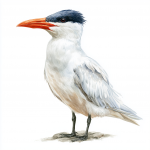
Blyth’s Reed Warbler
Acrocephalus dumetorum
Blyth's Reed Warbler is a rare migrant to Britain, typically seen during the spring and autumn periods, with most sightings occurring in the eastern and southern regions of the country. It is more commonly found in its breeding grounds across the Palearctic region and wintering grounds in South Asia.
Field Identification Guide
Use these features to identify Blyth’s Reed Warbler in the field.
The Blyth's Reed Warbler can be identified by its brownish-grey back, white underside, and distinctive whitish eyebrow stripe, as well as its relatively long and rounded tail.
The Blyth's Reed Warbler is slightly smaller than a House Sparrow, with a more slender build.
The male Blyth's Reed Warbler has a brownish-grey upperparts and white underparts, with a faint streaking on the breast and flanks, and a distinctive whitish eyebrow stripe above its eye.
The female Blyth's Reed Warbler has similar plumage to the male, with no notable differences in colouration or pattern.
The Blyth's Reed Warbler's call is a sharp, metallic "tek" or "tink" sound, while its song is a melodic and repetitive phrase, often described as a series of whistled notes.
Blyth's Reed Warblers are skulking birds that feed on insects and spiders, often foraging in dense vegetation, and can be seen flying with a rapid, darting motion between reed beds and shrubs.
The Blyth's Reed Warbler can be confused with the Reed Warbler, but can be distinguished by its longer and more rounded tail, and its distinctive whitish eyebrow stripe, as well as its more subdued and streaked breast and flanks.
Quick Facts
Who's spotted this?
Loading...
Recent community sightings
Loading recent sightings...