Grey Partridge
Perdix perdix
The Grey Partridge is a native British bird, commonly seen in open countryside, farmland, and grasslands, particularly during the breeding season from April to July. It is a relatively rare sight in Britain, with declining populations, but can still be spotted in certain areas, especially in the eastern and southern regions.
Field Identification Guide
Use these features to identify Grey Partridge in the field.
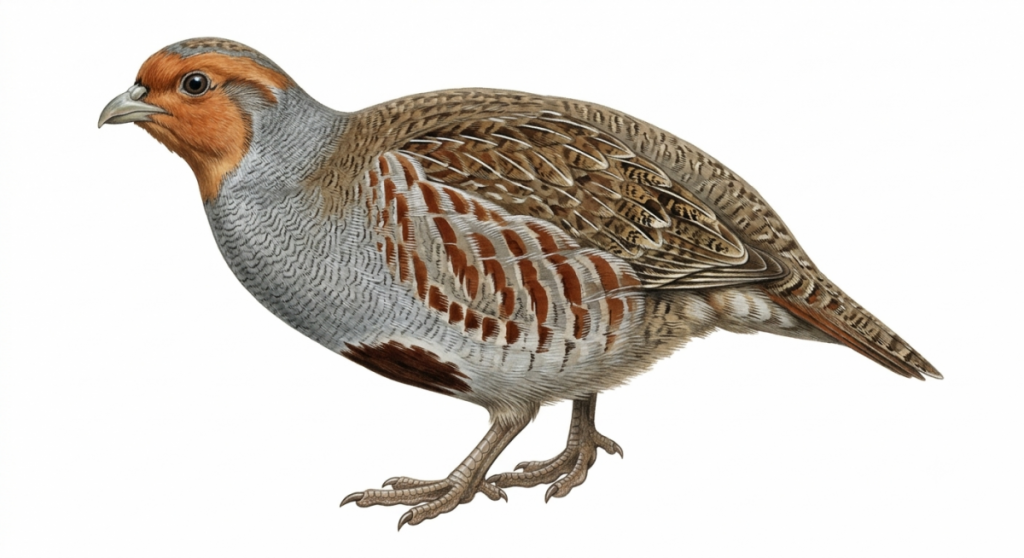
The Grey Partridge can be identified by its grey-brown plumage, distinctive black stripe running down its neck, and white belly, as well as its stocky build and short tail.
The Grey Partridge is slightly larger than a Blackbird, but smaller than a Pheasant.
The male Grey Partridge has a brownish-grey back, wings, and tail, with a black stripe running down its neck, and a white belly, with orange-brown face and throat patches.
The female Grey Partridge is similar to the male, but with a more subdued colouration, and a less distinct black neck stripe.
The Grey Partridge's call is a loud, shrill "ki-chi-chi" or "ket-ket-ket", often heard during the breeding season.
Grey Partridges are ground-dwelling birds, feeding on seeds, grains, and insects, and are often seen running or flying low to the ground, with a distinctive whirring sound, when disturbed.
The Grey Partridge can be confused with the Red-legged Partridge, but can be distinguished by its grey-brown plumage, lack of red legs, and distinctive black neck stripe, as well as its more subdued call.
Quick Facts
Who's spotted this?
Loading...
Recent community sightings
Loading recent sightings...