Lesser Spotted Woodpecker
Dryobates minor
The Lesser Spotted Woodpecker is a small, inconspicuous woodpecker that can be seen in Britain, particularly in woodland edges and gardens with trees, although it is one of the rarest and most elusive woodpeckers in the country. It is typically spotted during its breeding season, from March to July, in the southern and eastern parts of England.
Field Identification Guide
Use these features to identify Lesser Spotted Woodpecker in the field.
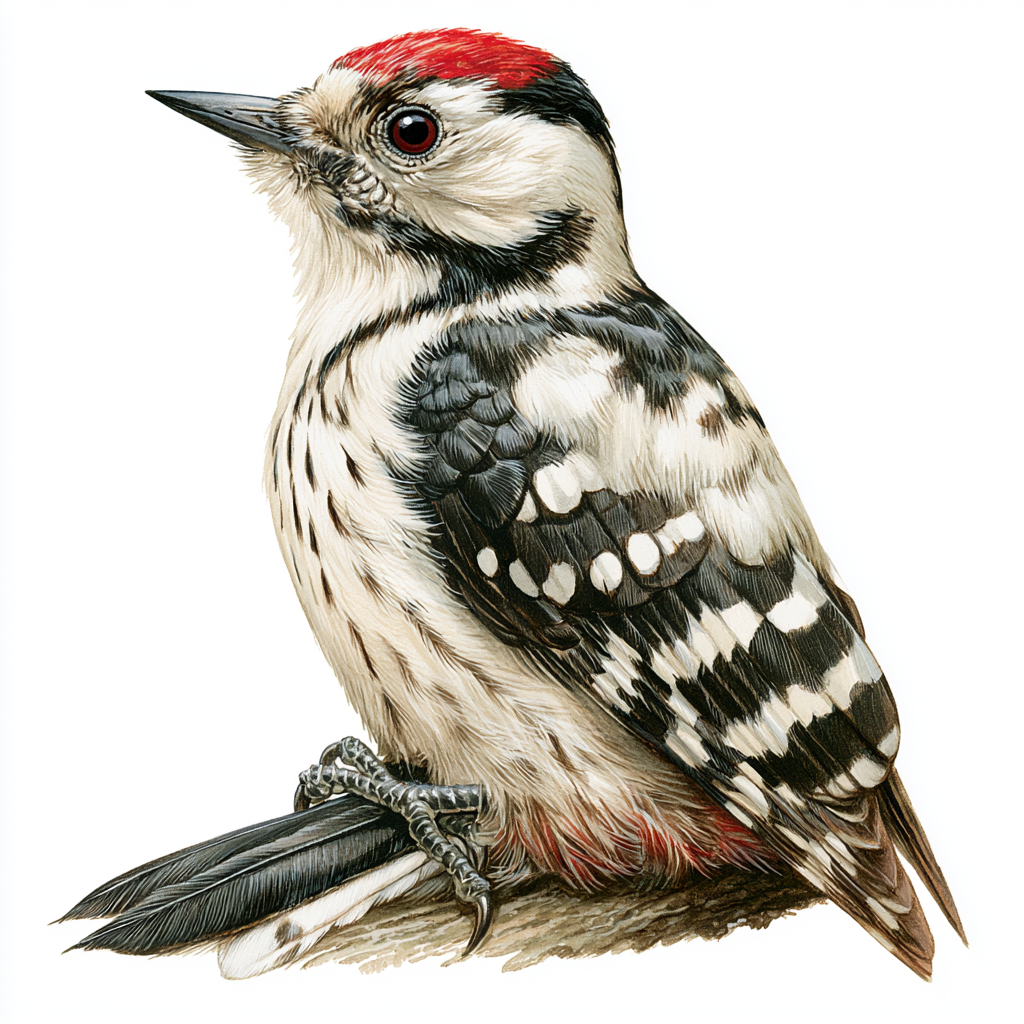
The Lesser Spotted Woodpecker can be identified by its black and white striped back, white forehead, and red crown on the male, as well as its small size and rounded head. Its white cheeks and black stripe above the beak are also distinctive features.
The Lesser Spotted Woodpecker is smaller than a Starling, measuring around 10-12 cm in length, and is one of the smallest woodpeckers in Britain.
The male Lesser Spotted Woodpecker has a black back with white stripes, a white forehead, and a red crown, with a black stripe above the beak and white cheeks, while its belly is white with black stripes.
The female Lesser Spotted Woodpecker is similar to the male but lacks the red crown, having a black crown instead, and has a slightly duller plumage overall.
The Lesser Spotted Woodpecker's call is a high-pitched, sharp "pic" or "pick" sound, often repeated in a series, while its song is a fast, drumming rhythm on trees.
The Lesser Spotted Woodpecker feeds on insects and sap, often climbing up trees in a spiral motion, and has a direct, swift flight style, with a habit of freezing in place when alarmed, making it difficult to spot.
The Lesser Spotted Woodpecker can be confused with the Great Spotted Woodpecker, but can be distinguished by its smaller size, lack of black stripe on the cheek, and red crown on the male, as well as its higher-pitched call and more rapid drumming rhythm.
Quick Facts
Who's spotted this?
Loading...
Recent community sightings
Loading recent sightings...