Broad-billed Sandpiper
Calidris falcinellus
The Broad-billed Sandpiper is a rare migrant to Britain, typically seen during the autumn, with most sightings occurring on the eastern and northern coasts. It can be found on muddy estuaries, marshes, and wet meadows, often in small flocks.
Field Identification Guide
Use these features to identify Broad-billed Sandpiper in the field.
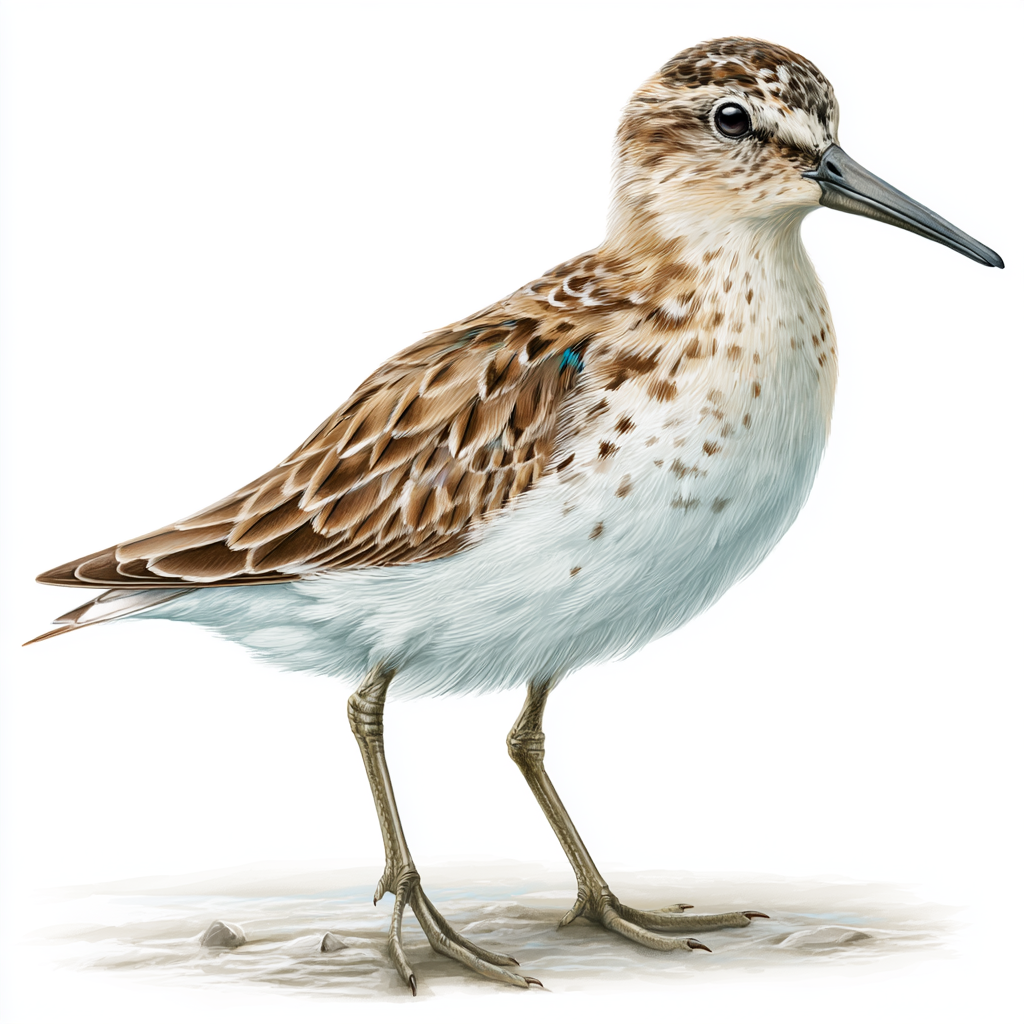
The Broad-billed Sandpiper can be identified by its broad, black bill, distinctive white eyebrow stripe, and dark grey-brown upperparts with pale fringes to the feathers.
The Broad-billed Sandpiper is smaller than a Starling, measuring around 17-20 cm in length.
The male Broad-billed Sandpiper has a dark grey-brown back and wings, with a pale breast and belly, and a distinctive black stripe running through the centre of the breast during the breeding season.
The female plumage is similar to the male, but with a less pronounced black stripe on the breast.
The Broad-billed Sandpiper's call is a sharp, high-pitched "chip" or "tick" sound, often repeated in a series.
The Broad-billed Sandpiper is a probing feeder, using its broad bill to search for small invertebrates in mud and wet soil, and it has a distinctive, erratic flight style.
The Broad-billed Sandpiper can be confused with other small waders, such as the Curlew Sandpiper and the Dunlin, but can be distinguished by its broad bill and distinctive white eyebrow stripe.
Quick Facts
Who's spotted this?
Loading...
Recent community sightings
Loading recent sightings...