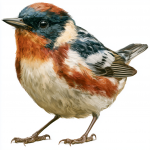
Veery
Catharus fuscescens
The Veery is a rare migrant to Britain, typically seen during the autumn months, and is most notable for being one of the smaller thrush species to occasionally appear in the country. It is usually spotted in woodland edges and scrubby areas, particularly in the western and southern regions of the UK.
Field Identification Guide
Use these features to identify Veery in the field.
At a glance, the Veery can be identified by its brown upperparts, pale yellowish-buff breast, and distinctive buffy-yellow wing bars, as well as its relatively small size and rounded head shape.
The Veery is smaller than a Song Thrush, roughly comparable in size to a Redwing.
The male Veery has a reddish-brown back and wings, a pale yellowish-buff breast and belly, and a greyish-brown head with a distinctive buffy-yellow wing bar, with little to no seasonal variation in its plumage.
Similar to the male, the female Veery's plumage is virtually indistinguishable, with the same reddish-brown and buffy-yellow colouration.
The Veery's call is a sharp, descending whistle, often described as a melancholic, haunting sound, while its song is a series of descending, whistled phrases.
Veeries are ground-foraging birds, feeding on insects, fruits, and berries, and are often seen flying low to the ground with a swift, direct flight style, frequently making short, abrupt stops.
The Veery can be confused with other Catharus thrushes, such as the Grey-cheeked Thrush, but can be distinguished by its warmer, more reddish-brown upperparts and distinctive buffy-yellow wing bars.
Quick Facts
Who's spotted this?
Loading...
Recent community sightings
Loading recent sightings...