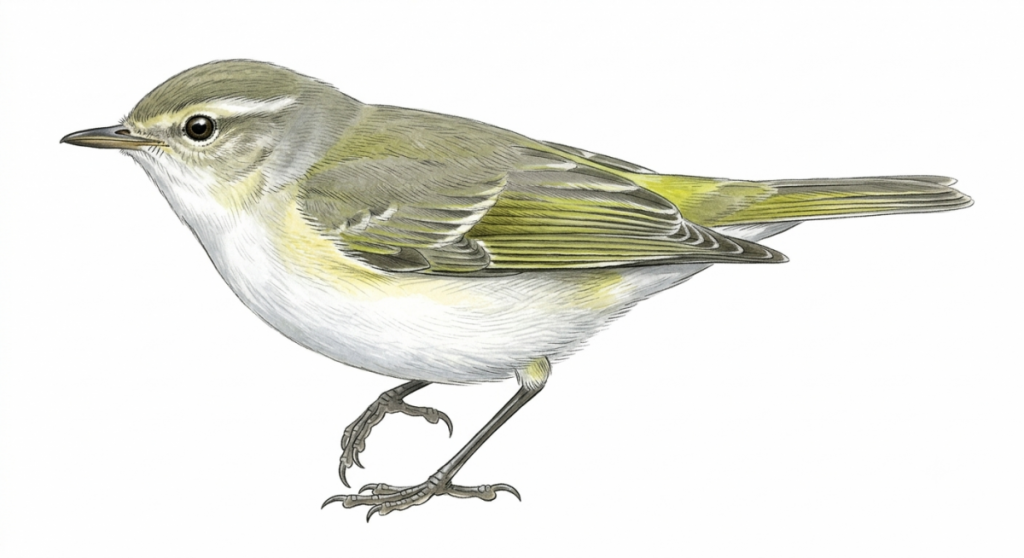
Western Bonelli’s Warbler
Phylloscopus bonelli
The Western Bonelli's Warbler is a rare migrant to Britain, typically seen in the southern regions during the spring and autumn, with occasional sightings in other parts of the country. It is more commonly found in its breeding grounds in southwest Europe and north Africa.
Field Identification Guide
Use these features to identify Western Bonelli’s Warbler in the field.
This species can be identified by its plain greenish-yellow plumage, white wing bars, and a distinctive white eye-ring, which distinguishes it from other warblers. Its lack of distinctive markings and uniform coloration also helps to set it apart.
The Western Bonelli's Warbler is smaller than a House Sparrow, measuring around 10-12 cm in length.
The male Western Bonelli's Warbler has a bright greenish-yellow plumage with a yellowish tint on the breast and belly, and white wing bars, with little to no seasonal variation.
The female Western Bonelli's Warbler is similar to the male, with a slightly duller coloration, but overall, the sexes are alike in terms of plumage.
The Western Bonelli's Warbler has a distinctive, melodic song, often described as a series of whistled phrases, and a sharp, metallic call note.
This species is an active forager, feeding on insects and spiders in woodland edges and scrubby areas, with a nimble, darting flight style and a tendency to flit between branches.
The Western Bonelli's Warbler can be confused with other Phylloscopus warblers, such as the Wood Warbler or the Chiffchaff, but can be distinguished by its plain plumage, white eye-ring, and distinctive call and song.
Quick Facts
Who's spotted this?
Loading...
Recent community sightings
Loading recent sightings...


