Red-breasted Goose
Branta ruficollis
The Red-breasted Goose is a rare but striking winter visitor to Britain, typically seen in small numbers along the eastern and southern coasts from October to March. It is most often encountered in areas with coastal wetlands, estuaries, and grasslands, where it can be found in the company of other goose species.
Field Identification Guide
Use these features to identify Red-breasted Goose in the field.
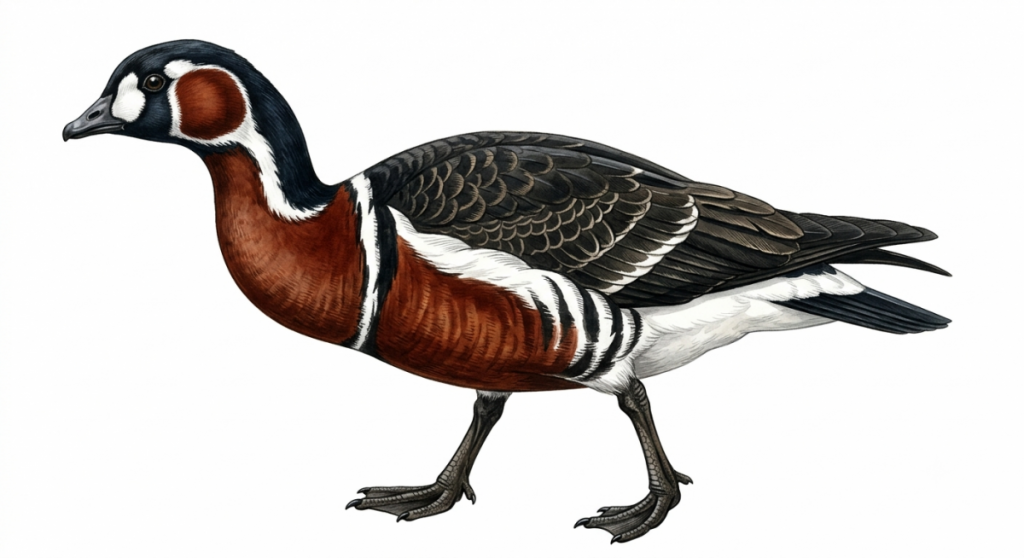
The Red-breasted Goose can be identified at a glance by its distinctive black neck collar, white face patches, and reddish-brown breast, as well as its relatively small size and dark brown back. Its bright colouration and striking markings make it a standout among other goose species.
The Red-breasted Goose is slightly larger than a Mallard, but smaller than a Greylag Goose, with a more compact and streamlined build.
The male Red-breasted Goose has a black head and neck, with a distinctive black neck collar and white face patches, a reddish-brown breast and belly, and dark brown back and wings, with a seasonal variation in the intensity of the breast colour.
The female Red-breasted Goose is similar to the male, with slightly duller and less intense colouration, particularly on the breast and head.
The Red-breasted Goose has a high-pitched, cackling call, often described as a loud, sharp "kyek-kyek-kyek" or "krek-krek-krek", which is frequently heard when the birds are in flight or alarmed.
Red-breasted Geese are social birds that feed on grasses, leaves, and aquatic plants, often in large flocks with other goose species, and are known for their fast and direct flight style, with a steady wingbeat and a distinctive "V" formation.
The Red-breasted Goose can be confused with the Brent Goose or the White-fronted Goose, but can be distinguished by its distinctive black neck collar, white face patches, and reddish-brown breast, as well as its smaller size and more compact build.
Quick Facts
Who's spotted this?
Loading...
Recent community sightings
Loading recent sightings...