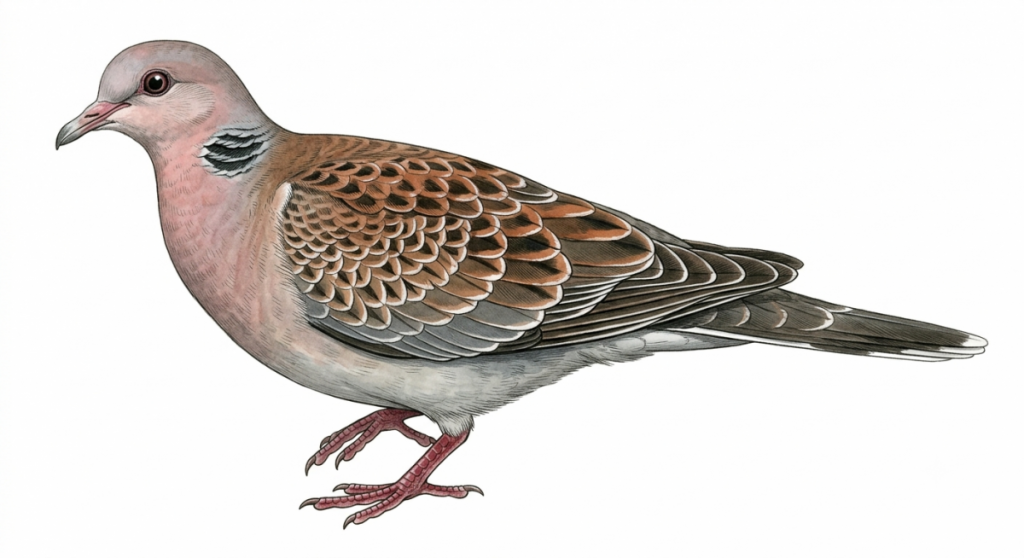
Oriental Turtle Dove
Streptopelia orientalis
The Oriental Turtle Dove is a rare vagrant in Britain, with sightings typically occurring during the summer and autumn months, often in the southern and eastern regions. It is more commonly found in its native range across Asia, but occasional individuals may appear in the UK, particularly during periods of easterly winds.
Field Identification Guide
Use these features to identify Oriental Turtle Dove in the field.
The Oriental Turtle Dove can be identified by its distinctive black neck patch with white edges, brownish-grey upperparts, and scaly pattern on its neck and breast. Its black tail with white outer feathers is also a notable feature, as is its overall sturdy build and rounded tail.
The Oriental Turtle Dove is slightly larger than a Woodpigeon, but smaller than a Stock Dove, making it a medium-sized bird.
The male Oriental Turtle Dove has a brownish-grey back, wings, and tail, with a black neck patch bordered by white, and a scaly pattern on its neck and breast, with a reddish-brown tint to its wings and tail.
The female Oriental Turtle Dove is similar to the male, but with a slightly duller plumage and less distinct black neck patch.
The Oriental Turtle Dove's call is a low, mournful "coo-coo-coo" sound, often repeated in a series of three to five notes.
The Oriental Turtle Dove is a ground-foraging bird, feeding on seeds, grains, and other plant material, and is often seen walking or running on the ground in search of food, with a deliberate and unhurried pace.
The Oriental Turtle Dove can be confused with the European Turtle Dove, but can be distinguished by its black neck patch with white edges, and its more reddish-brown wings and tail, as well as its larger size and more scaly pattern on its neck and breast.
Quick Facts
Who's spotted this?
Loading...
Recent community sightings
Loading recent sightings...


