Pechora Pipit
Anthus gustavi
The Pechora Pipit is a rare migrant to western Europe, including Britain, where it can be spotted in September and October, typically in coastal areas and wetlands. It is a small, ground-dwelling bird that breeds in the East Palearctic tundra and densely vegetated areas near river banks, but its appearances in Britain are fleeting and uncommon.
Field Identification Guide
Use these features to identify Pechora Pipit in the field.
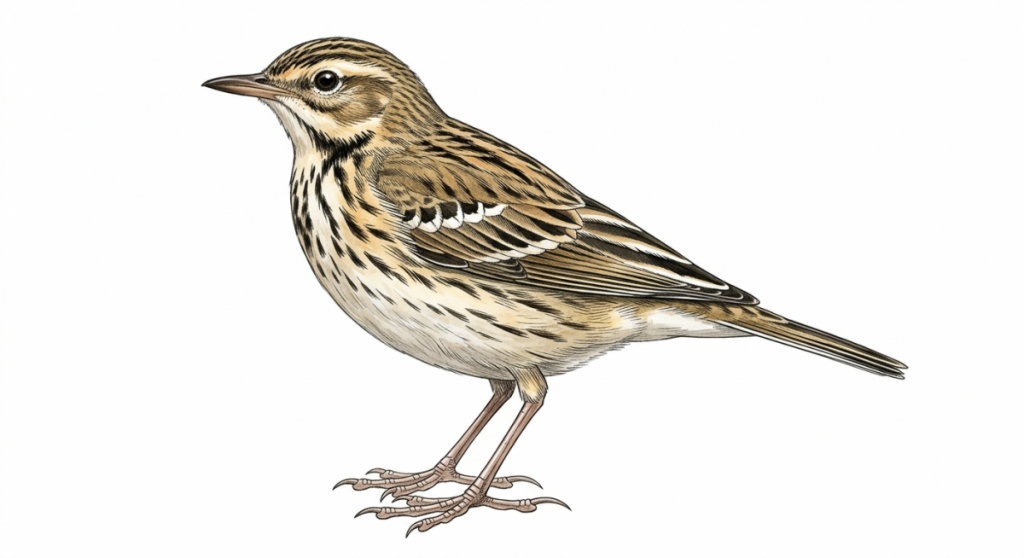
The Pechora Pipit can be identified by its streaked breast, pale yellowish-buff underside, and distinctive head pattern featuring a pale supercilium and dark stripe through the eye. Its overall plumage is a mix of brown, grey, and yellowish hues, with a distinctive black stripe above the lores.
The Pechora Pipit is smaller than a Starling, measuring around 12-14 cm in length, and is comparable in size to a Meadow Pipit.
The male Pechora Pipit has a streaked breast and flanks, with a pale yellowish-buff underside and a greyish-brown back, while its head features a pale supercilium and dark stripe through the eye.
The female Pechora Pipit is similar to the male, with subtle differences in the intensity of the streaking and colouration, but overall, the female's plumage is nearly indistinguishable from that of the male.
The Pechora Pipit's call is a sharp, high-pitched "tzee" or "tzeep" sound, often repeated in a series, while its song is a melodic, whistled phrase that is rarely heard in Britain.
The Pechora Pipit is a ground-dwelling bird that feeds on insects, seeds, and small invertebrates, often running or walking on the ground in search of food, and when alarmed, it will take to flight, revealing its long, pointed wings and erratic flight pattern.
The Pechora Pipit can be confused with other pipit species, such as the Tree Pipit and the Meadow Pipit, but can be distinguished by its streaked breast, pale yellowish-buff underside, and distinctive head pattern, as well as its smaller size and more slender build.
Quick Facts
Who's spotted this?
Loading...
Recent community sightings
Loading recent sightings...