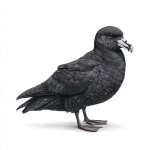
Black-throated Thrush
Turdus atrogularis
The Black-throated Thrush is a rare winter visitor to Britain, typically seen in the southern and eastern regions from October to April, with most sightings occurring during periods of cold weather on the continent. It is a scarce but annual visitor to the UK, with only a handful of records each year.
Field Identification Guide
Use these features to identify Black-throated Thrush in the field.
The Black-throated Thrush can be identified by its grey-brown back, white underside, and distinctive black throat patch, as well as its reddish-brown wings and tail. Its dark cheek patches and pale yellow bill are also notable features.
The Black-throated Thrush is slightly larger than a Song Thrush, but smaller than a Mistle Thrush.
The male Black-throated Thrush has a grey-brown back, white underside, and a black throat patch that extends as a partial collar around its neck, with reddish-brown wings and tail.
The female Black-throated Thrush is similar to the male, but with a slightly paler and more buff-toned throat patch and underside.
The Black-throated Thrush has a sharp, metallic call that sounds like "tik" or "tsik", and its song is a series of melodic phrases that are often described as sweet and whistled.
The Black-throated Thrush is a ground-foraging bird that feeds on insects, fruits, and berries, and is often seen running or hopping on the ground in search of food, with a distinctive flight style that involves rapid wingbeats and a swift, direct trajectory.
The Black-throated Thrush can be confused with the Redwing or the Song Thrush, but can be distinguished from these species by its black throat patch, reddish-brown wings and tail, and pale yellow bill, as well as its more subdued and grey-brown plumage.
Quick Facts
Who's spotted this?
Loading...
Recent community sightings
Loading recent sightings...