Rock Thrush
Monticola saxatilis
The Rock Thrush is a rare migrant to Britain, typically seen in the spring and autumn, often in coastal areas or on migration hotspots, with a few individuals occasionally lingering into the summer. It is more commonly associated with mountainous regions of southern Europe and Asia.
Field Identification Guide
Use these features to identify Rock Thrush in the field.
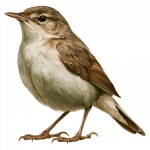
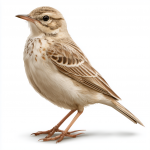
The Rock Thrush can be identified by its grey-brown back, white underside with dark spots, and a distinctive white wing bar, as well as its relatively long tail and legs.
The Rock Thrush is slightly smaller than a Blackbird, but larger than a Song Thrush.
The male Rock Thrush has a blue-grey head, back, and wings, with a white throat, breast, and belly, and dark spots on its underside, with some variation in intensity of colour depending on the season.
The female Rock Thrush is similar to the male but has a browner tint to its back and wings, and less intense spotting on its underside.
The Rock Thrush has a melodic, whistled song, often described as a series of clear, flute-like phrases, and a sharp, metallic call.
The Rock Thrush is an insectivorous bird that forages for food on or near the ground, often running or hopping in pursuit of prey, and has a swift, direct flight style.
The Rock Thrush can be confused with the Whinchat or the Wheatear, but can be distinguished by its larger size, longer tail, and distinctive white wing bar, as well as its spotted underside and blue-grey head in the case of the male.
Quick Facts
Who's spotted this?
Loading...
Recent community sightings
Loading recent sightings...