Common Crossbill
Loxia curvirostra
The Common Crossbill is a rare but occasional visitor to Britain, typically seen in coniferous woodlands, particularly during irruptions when food is scarce on the continent. It can be spotted in the UK, mainly in the north and east, although sightings are unpredictable and often linked to seed availability.
Field Identification Guide
Use these features to identify Common Crossbill in the field.
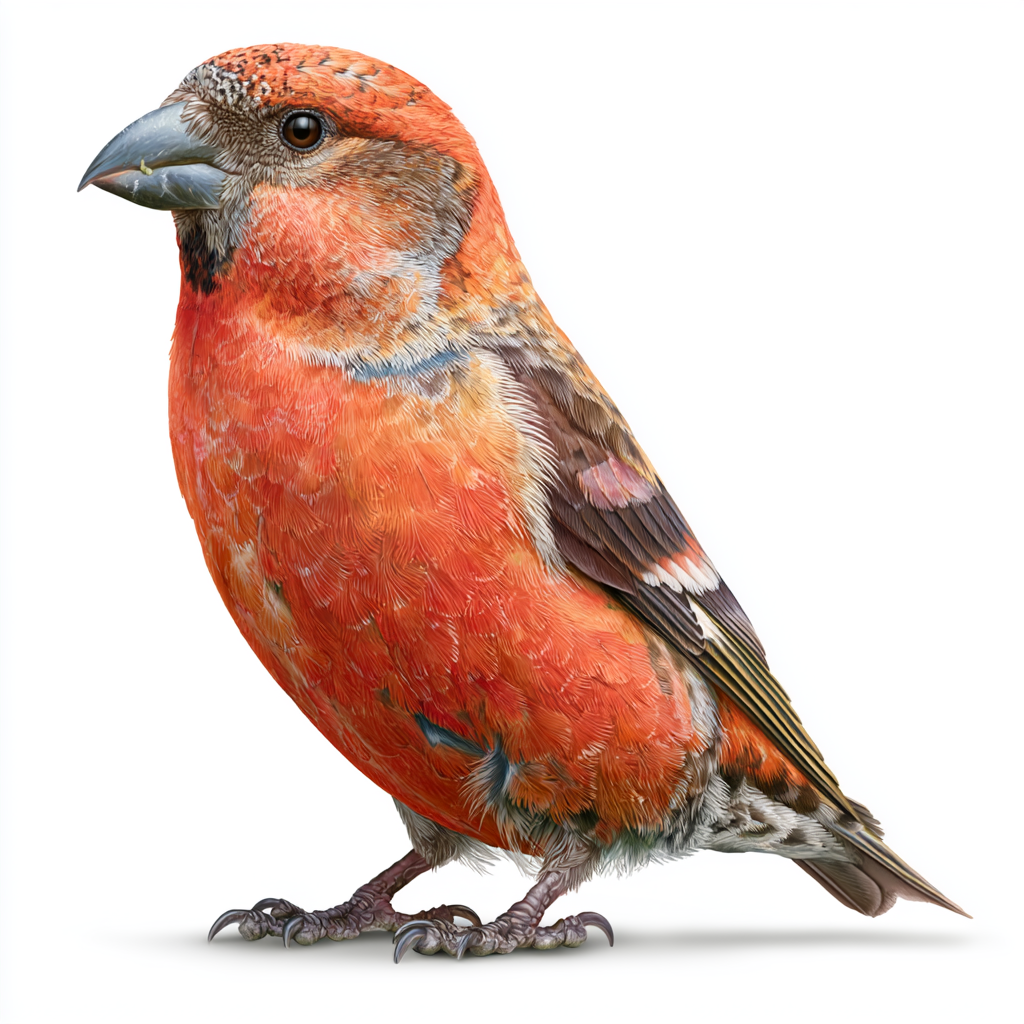
The Common Crossbill is distinguished by its distinctive crossed mandibles, a stout body, and a short, forked tail, with the males having a vibrant red plumage and the females a more subdued greenish-yellow hue. Its unique beak shape is a key identification feature, enabling it to extract seeds from conifer cones.
The Common Crossbill is slightly smaller than a Starling, with a length of approximately 16-17 cm.
The male Common Crossbill has a bright red plumage with brownish tints on the wings and tail, and a greyish-brown crown, with some variation in colour intensity depending on the subspecies and age.
The female Common Crossbill has a more subdued greenish-yellow plumage, with brownish tints on the wings and tail, similar to the male but lacking the vibrant red colouration.
The Common Crossbill's call is a sharp, metallic "chip-chip-chip" sound, often repeated in a series, while its song is a series of descending, whistled phrases.
The Common Crossbill is a specialist feeder, using its unique beak to extract seeds from conifer cones, and is often seen in small flocks, flying in a swift, direct manner between trees.
The Common Crossbill can be confused with the Parrot Crossbill, but can be distinguished by its smaller size, more slender beak, and less vibrant plumage, as well as its more frequent presence in Britain, although both species are rare and irregular visitors.
Quick Facts
Who's spotted this?
Loading...
Recent community sightings
Loading recent sightings...