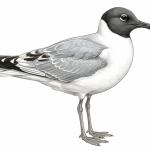
Garganey
Spatula querquedula
The Garganey is a rare but annual migrant to Britain, typically seen in the spring and autumn, with the majority of sightings occurring in eastern and southern England. It can be spotted in a variety of wetland habitats, including marshes, ponds, and estuaries.
Field Identification Guide
Use these features to identify Garganey in the field.
The Garganey can be identified by its distinctive head pattern, featuring a brown crown and greyish-brown forehead, as well as its bright brown breast and greyish-brown flanks, and its relatively small size and fast, twisting flight.
The Garganey is smaller than a Mallard, but larger than a Blue Tit.
The male Garganey has a striking plumage, with a brown crown, greyish-brown forehead, and a bright brown breast, as well as greyish-brown flanks and a black rear end, with a white stripe above the eye and a pale blue-grey bill.
The female Garganey is similar to the male, but with a more subdued colouration, featuring a brown crown and greyish-brown forehead, but lacking the bright brown breast and greyish-brown flanks of the male.
The Garganey's call is a sharp, nasal "krek" or "krrek" sound, often repeated in a series.
The Garganey is a dabbling duck, feeding on aquatic plants and small invertebrates in shallow water, and is known for its fast, twisting flight, which allows it to quickly take off from the water.
The Garganey can be confused with the Eurasian Teal, but can be distinguished by its larger size, more striking head pattern, and brighter brown breast, as well as its faster and more twisting flight.
Quick Facts
Who's spotted this?
Loading...
Recent community sightings
Loading recent sightings...