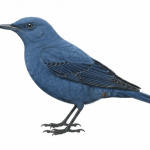
Little Whimbrel
Numenius minutus
The Little Whimbrel, also known as the Little Curlew, is a rare migrant to Britain, typically seen during its passage to and from its Arctic breeding grounds, with sightings mostly limited to the eastern and northern coasts. It is a small wader that can be spotted in Britain during the summer months, although such occurrences are infrequent.
Field Identification Guide
Use these features to identify Little Whimbrel in the field.
The Little Whimbrel can be identified by its small size, long curved bill, and distinctive white stripes on its head and neck, which distinguish it from other similar species.
The Little Whimbrel is smaller than a Starling, with its compact body and long bill making it a notable sight among other waders.
The male Little Whimbrel has a mottled brown back and wings, with a pale underside and white stripes on its head and neck, although detailed information on its specific plumage patterns is limited due to its rarity in Britain.
Similar to the male, the female Little Whimbrel's plumage is not well-documented in British sightings, but it is presumed to be similar to that of the male, given the lack of distinct sexual dimorphism in this species.
The Little Whimbrel's call is a high-pitched, whistling sound, although detailed descriptions of its call are not widely available due to its rarity in Britain.
The Little Whimbrel is a ground-foraging bird that feeds on small invertebrates and plants, often running or walking to catch its prey, and when in flight, it has a swift and direct style, although such behaviour is rarely observed in Britain.
The Little Whimbrel can be confused with other small curlews, such as the Whimbrel, but it is distinguished by its smaller size, longer bill, and distinctive head stripes, which are key features to look out for when attempting to identify this rare species.
Quick Facts
Who's spotted this?
Loading...
Recent community sightings
Loading recent sightings...